
.jpg?w=3000&h=2000)
Long before the sun fully rises over the ancient labyrinth of Kashgar’s Old City, the air begins to hum. It starts as a solitary, crisp ding cutting through the morning mist, soon joined by a chorus of rhythmic strikes echoing down the narrow, sun-baked alleyways. This is not the mechanical roar of an industrial assembly line; it is the heartbeat of the Silk Road. Here, the clash of metal against metal is an ancient language, a symphony composed of fire, sweat, and unrelenting time. In an era defined by mass-produced uniformity and disposable trends, we invite you to step into the dimly lit workshops of the Uyghur coppersmiths. Here, we discover why true luxury cannot be manufactured by machines—it must be slowly, painstakingly forged by hand.

The Canvas: Red and Yellow
Every masterpiece requires the right canvas. For our artisans, this canvas comes in the form of raw metal sheets: authentic red copper and resilient brass. These two materials possess entirely different temperaments. Red copper is like the earth itself—warm, relatively soft, and remarkably forgiving. It yields to the hammer's guidance, stretching and expanding with a graceful elasticity that allows for sweeping, elegant forms. Brass, on the other hand, is a stubborn beast. It is hard, cold, and unyielding, demanding immense physical strength and infinite patience to tame. By marrying these two distinct metals, the artisans create vessels that are both structurally enduring and visually captivating. It is a delicate negotiation between human will and the uncompromising nature of the elements.
The Misgar's Rhythm
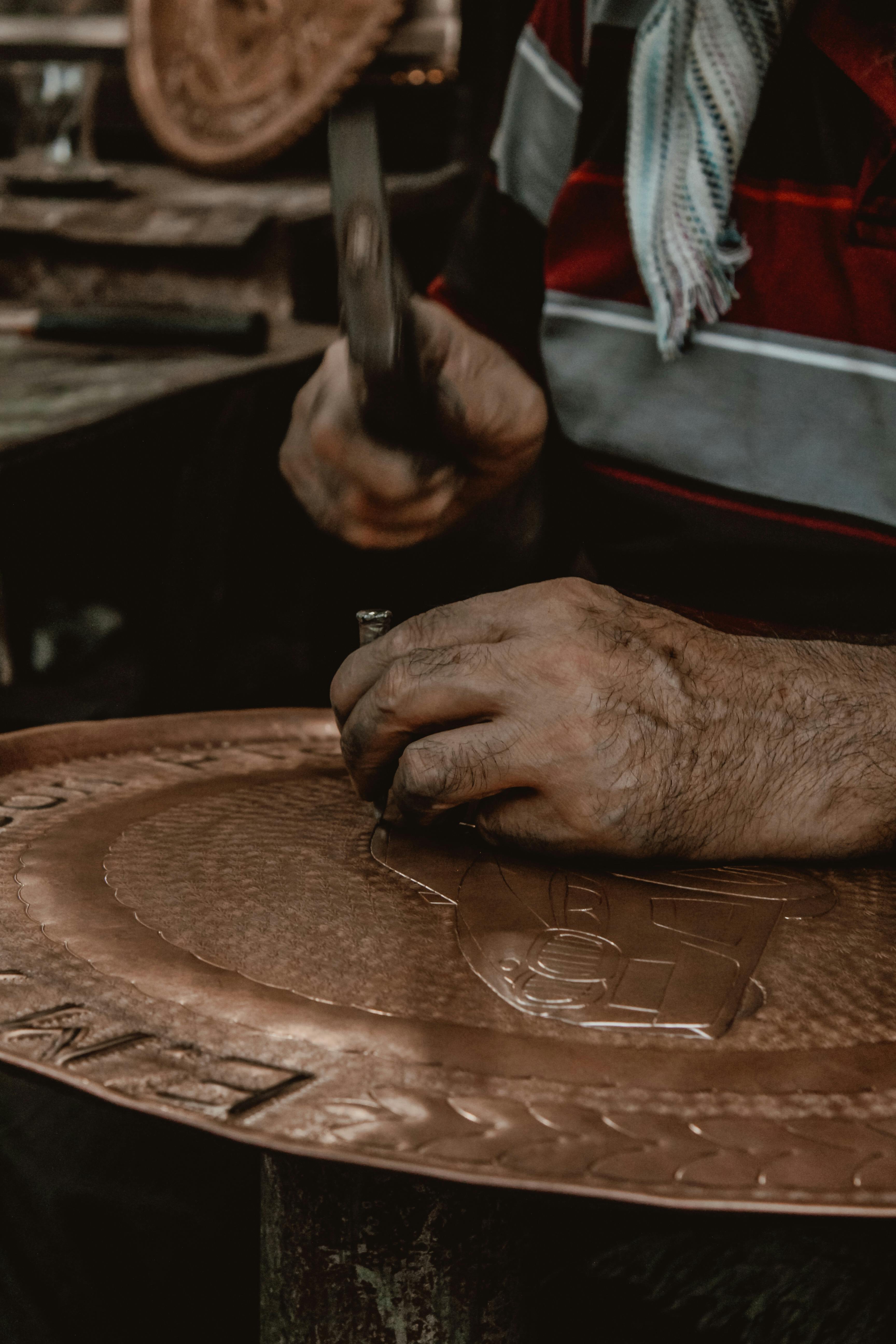
The men who command these metals are known locally as the Misgar—the master coppersmiths. Their craft is a solitary dance of fire and force, requiring absolute focus. Armed with massive iron shears, they first cut the raw metal sheets into rough geometries. Then begins the relentless, hypnotic rhythm of the hammer.
The Misgar alternate between heavy iron mallets and softer wooden hammers, striking the copper against a hardened anvil. Starting from the base of a future teapot, the artisan works his way upward. With each rotation, the copper wall must become progressively thinner, and the strikes must grow increasingly delicate. A master Misgar will spend an entire day laboring over a single vessel, striking it thousands of times until the metal wall is flawlessly uniform, as if it had never been beaten at all.
Yet, the absolute true test of a Misgar’s skill lies in the spout. There are no blueprints, no precision molds, and no digital measurements in these workshops. The perfect, sweeping curve of a teapot’s spout is coaxed from the solid metal entirely through decades of muscle memory and intuitive grace. It is a profound demonstration of tacit knowledge—a mastery felt deep in the bones, passed down from father to son.
The Mark of the Maker
If you run your fingers along the surface of our vintage copperware, you will not find the mirror-like, flawless smoothness of factory-made goods. Instead, you will feel a topography of subtle indentations—the hammer marks. In the philosophy of wabi-sabi, these textured ripples are not flaws; they are the maker's indelible fingerprints. They are the physical proof of human effort, capturing the exact amount of force and the specific angle applied by the Misgar on a specific day in history.
Furthermore, these vessels are living artifacts. Unlike synthetic materials that degrade and crack over time, raw copper matures. As it interacts with the oils of your skin and the air in your home, the metal will slowly oxidize, developing a rich, multi-layered patina. This natural aging process ensures that no two pieces will ever look identical. Over the years, the vessel will absorb the stories of your household, transforming from a beautiful object into an irreplaceable family heirloom.
Bring the Echo Home
The journey of our copperware is one of remarkable transition. It begins in the fiery, soot-stained workshops of Central Asia, born from deafening strikes and generations of inherited wisdom. Ultimately, it finds its rest on a minimalist dining table in New York, a rustic mantle in London, or a quiet reading nook in your modern sanctuary.
In a world moving recklessly fast, bringing one of these vessels into your home is an act of quiet rebellion. It is a daily reminder to appreciate the weight of time, the beauty of imperfection, and the profound quietude of slow, deliberate craftsmanship.
The echoes of the Misgar are waiting to resonate in your space.